
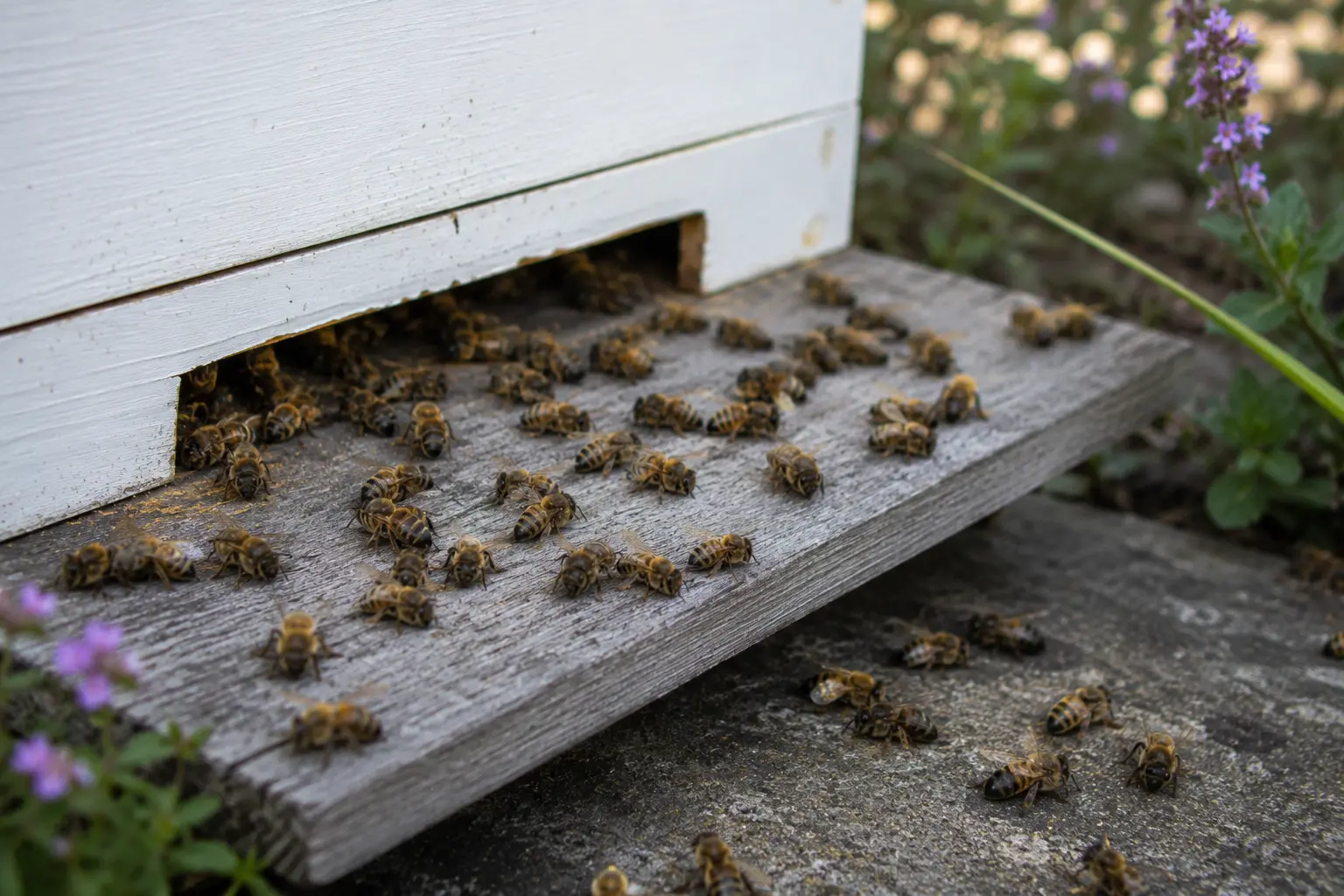
Suspected poisoning and sudden bee deaths
Pesticide Poisoning in Bees: Signs and What To Do
Last updated: 15 August 2026
Pesticide poisoning is one possible explanation when a beekeeper finds a sudden pile of dead, dying or crawling bees outside a hive. It is especially concerning when the incident appears quickly, affects several colonies at the same time, or follows spraying, crop treatment, garden chemical use or another obvious chemical exposure nearby.
Even so, suspected poisoning should be approached carefully. Dead bees outside the hive can also be caused by starvation, robbing, varroa-related collapse, disease, old winter bees dying off, bad weather, queen problems or a colony already under stress. The aim is not to jump to a conclusion, but to record clear evidence and seek proper advice where the pattern looks suspicious.
This page explains the main warning signs, what pesticide poisoning can look like at the hive entrance, what other problems can mimic it, and what UK beekeepers should do next.
Possible signs of pesticide poisoning in bees
Suspected pesticide poisoning often stands out because of the speed and scale of the incident. A colony may appear normal one day, then show large numbers of dead or dying bees at the entrance the next. You may see bees crawling in circles, trembling, spinning, unable to fly, or dying in front of the hive. In some cases, dead bees may have their tongues extended.
The wider pattern matters more than one sign on its own. A sudden incident affecting several colonies in the same apiary is more suspicious than a small number of dead bees outside one hive. It is also more concerning if the weather has been suitable for flying, the colony was previously strong, and there has been nearby spraying, crop treatment or chemical use.
A sudden drop in flying bees can also be a clue. If many foragers are lost away from the hive, the colony may become unexpectedly quiet, with fewer returning bees than you would expect for the weather and time of year.
What pesticide poisoning can look like at the hive
At the entrance, you may see dead bees scattered across the landing board, ground or grass in front of the hive. Some bees may still be alive but unable to fly properly. They may stagger, tremble, spin, crawl away from the hive or appear disorientated. Guard bees may also drag affected bees away from the entrance.
Inside the hive, the picture can vary. Some colonies may still have healthy brood and a laying queen but have lost many foragers. Others may show wider stress if the exposure was severe. If the colony has already been weakened by varroa, starvation or disease, the final collapse may look more dramatic and can be harder to interpret.
Dead bees with tongues out are often mentioned in relation to poisoning, but that sign should not be used as proof by itself. It should be treated as one piece of evidence alongside timing, scale, nearby activity, colony history and whether neighbouring colonies are showing the same symptoms.
Other causes of dead or crawling bees
Not every pile of dead bees is caused by pesticide poisoning. In winter and early spring, older bees may die naturally and be cleared from the hive when the weather improves. During cold weather, starvation or isolation starvation can leave dead bees inside or around the hive, especially if the cluster could not reach food.
Varroa and virus pressure can also cause crawling bees, trembling, weak workers and colony decline. Deformed wing virus is often linked with bees crawling on the ground or emerging with damaged wings. Robbing can leave dead bees at the entrance after fighting, while wasp attacks, queen failure or brood disease may weaken a colony and make losses more noticeable.
The best approach is to compare the incident with the colony’s recent history. A sudden event after nearby spraying points more strongly towards possible poisoning. A gradual decline with deformed wings, poor brood, mite pressure or dwindling bees may point more towards varroa, disease or queen-related problems.
What to record immediately
Good records matter because poisoning concerns are difficult to assess after the scene has been cleared or the weather has changed. Take clear photos of the hive entrance, the dead bees, the surrounding ground and the wider apiary. If more than one colony is affected, photograph each entrance separately so the pattern is clear.
Write down the date, time, apiary location, weather conditions, affected hive names and what you saw. Record whether the bees were dead, crawling, trembling, spinning, unable to fly, or being removed by other bees. It is also useful to note whether the colony was previously strong, whether it had brood, whether it had been fed or treated recently, and whether there were any signs of varroa, robbing or starvation.
If you know of nearby spraying, crop treatment, garden chemical use or other activity, record it factually. Avoid accusations or assumptions. A clear timeline is much more useful than a rushed conclusion.
Samples and reporting
If poisoning is suspected, contact your local bee inspector or the National Bee Unit for guidance. They can advise whether the incident needs further investigation and whether any samples should be collected. Do not guess the sampling process yourself, because poor collection or storage can reduce the value of the evidence.
If you are advised to keep a sample, follow the instructions you are given. The key point is to avoid disturbing or disposing of all the evidence before you have taken photographs and sought advice. If the incident is serious, affects several colonies, or appears linked to recent chemical use, it is better to ask promptly rather than wait several days.
What not to do if you suspect poisoning
Do not clear away all the dead bees before taking photos and recording the pattern. Do not move frames, bees or equipment between colonies until you have considered whether disease, robbing or contamination could be involved. If several colonies are affected, avoid unnecessary hive manipulation until you have a clearer picture.
It is also important not to accuse a neighbour, farmer, landowner or contractor without evidence. Nearby spraying may be relevant, but it does not automatically prove the cause. A calm, factual record gives you a stronger basis for seeking advice and avoids making the situation harder to resolve.
Do not ignore other possible causes. If the colony also has deformed wings, heavy mite drop, poor brood, low stores or signs of robbing, those details should be recorded as well. The more complete the picture, the easier it is to decide what is most likely.
How HiveTag can help you build a clear timeline
If you use HiveTag, record the incident as soon as possible against the affected apiary and hive. Add photos, inspection notes, weather conditions, the number of colonies affected and any nearby activity you are aware of. This gives you a timeline that can be compared with previous inspections, feeding, varroa treatments, queen status and colony strength.
Hive records are particularly useful where symptoms overlap. A colony that was strong last week and suddenly loses flying bees after nearby spraying tells a different story from a colony that has been declining for weeks with mite pressure, poor brood and deformed wings. Clear records help you separate sudden incidents from longer-term colony health problems.
You can also use the Bee Health Checker or Colony Health Triage Tool to compare suspected poisoning with other causes of dead, crawling or dying bees.
Bee Poisoning FAQ
No. Extended tongues can be seen in poisoning cases, but they are not proof on their own. The wider pattern matters, including sudden losses, abnormal movement, nearby spraying and whether several colonies are affected.
Contact your local bee inspector or the National Bee Unit for advice. They can advise whether samples are needed and what evidence should be recorded.
Some colonies can recover if the queen, nurse bees and brood remain healthy, but severe incidents can weaken or kill a colony, especially if large numbers of foragers are lost.
Yes. Some signs can overlap, especially crawling or dying bees. Varroa collapse is often linked with mite pressure, deformed wings and gradual weakening, while poisoning is usually more sudden.