
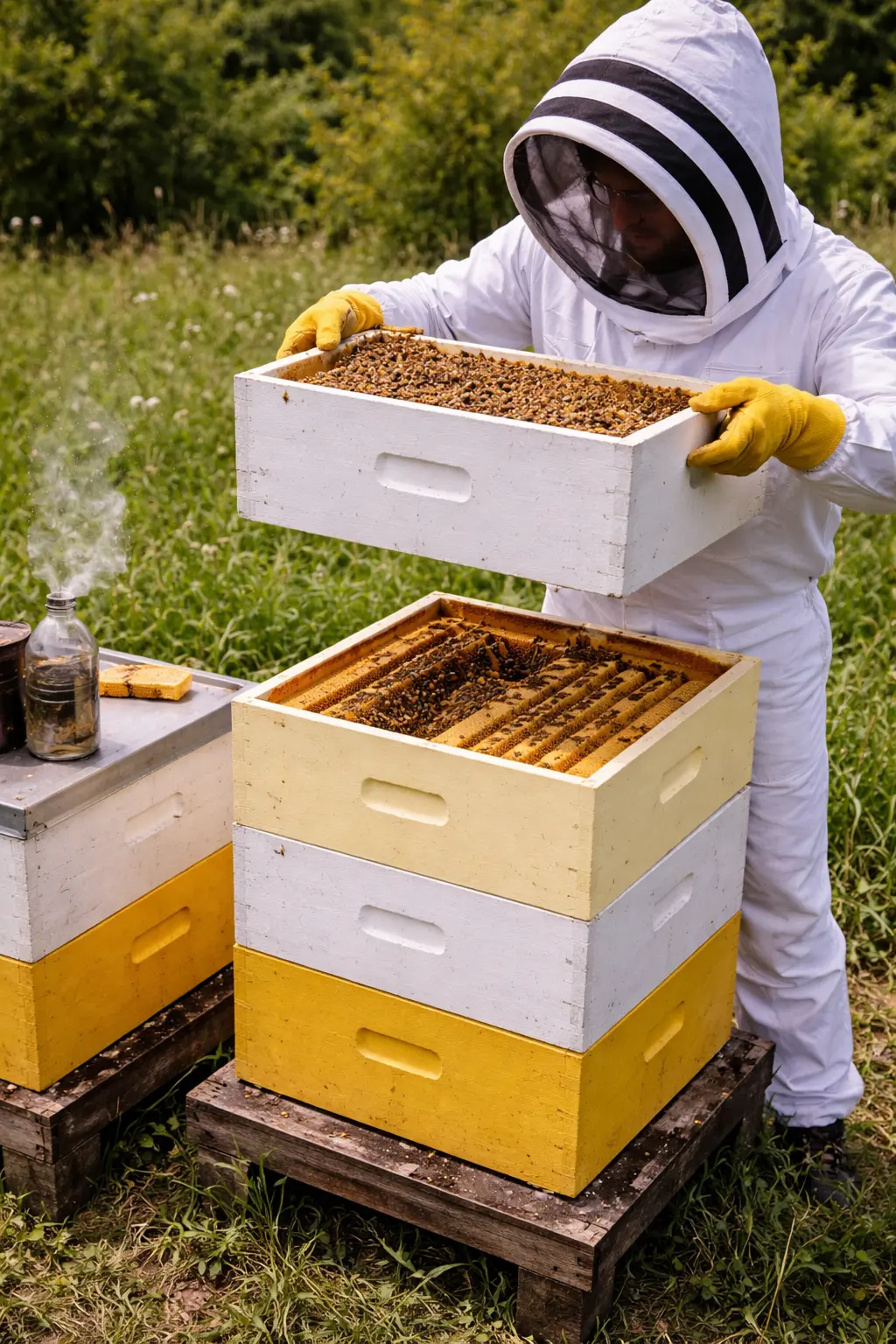
Splitting a Hive (UK)
How to Split a Hive to Prevent Swarming (UK)
Last updated: 15 August 2026
Splitting a hive is one of the most effective ways to prevent swarming. Instead of allowing the colony to divide naturally and lose half your bees, you create that split yourself in a controlled way. If you want to reduce the risk of swarming more generally, see Swarm Prevention.
This reduces pressure inside the hive, interrupts swarm preparation, and allows you to keep both halves of the colony under your management.
This guide explains when to split a hive, how the method works, and outlines a simple approach suitable for beginners in the UK.
Hive Splitting – At a Glance
Purpose
- Prevent swarming
- Reduce congestion
- Create a second colony
When to Do It
- Strong spring colony
- Before or early queen cell stage
- During swarm season
Outcome
- Two smaller colonies
- Swarm impulse reduced
- More control over queens
Why Splitting Works
Swarming happens when a colony becomes crowded, strong, and ready to reproduce. This is usually linked to the development of queen cells within the hive. By splitting the hive, you are effectively doing what the bees were about to do — but in a controlled way.
You remove bees, brood, and resources from the original colony, reducing congestion and breaking the swarm impulse. At the same time, you create a second colony that can develop into a productive hive.
When Should You Split a Hive?
Timing is critical. The best time to split is when the colony is strong but before swarming has progressed too far.
- Brood box full of bees and brood
- Increasing drone presence
- Warm weather and steady forage
- Early queen cups or first queen cells appearing
If the colony already has multiple capped queen cells, you may need a more controlled approach such as an artificial swarm.
Simple Hive Split (Beginner Method)
This is one of the easiest ways to split a hive and reduce swarm pressure without complicated techniques.
- A second brood box
- Frames (drawn if possible)
- A floor and roof
- A new hive position nearby
Step-by-step:
- Find the brood frames — especially those with eggs and young larvae.
- Move 3–5 brood frames into a new box (include bees on them).
- Add a frame with food (honey/pollen).
- Fill remaining space with empty or drawn frames.
- Place the new hive a short distance away.
The original colony keeps most flying bees, while the split develops more slowly.
What Happens After the Split
After splitting, the two colonies will develop differently:
- The original hive usually remains strong and continues foraging
- The new split will raise a queen or accept one if introduced
- Brood production temporarily slows in the split
If the new colony is raising its own queen, it will follow the same timeline described in the Queen Cell Timeline.
It may take a few weeks before you see eggs in the new colony.
Do You Need to Find the Queen?
Not always. Many simple splits are done without locating the queen. However, knowing where she is can give you more control over the outcome.
If you are unsure, see What To Do If You Can't Find the Queen.
Common Mistakes
Splitting is simple in principle, but a few mistakes can reduce its effectiveness:
- Splitting too late (after swarm has already happened)
- Not moving enough bees or brood
- Leaving the split too weak
- Opening the new colony too frequently
Split vs Artificial Swarm
A simple split and an artificial swarm are closely related, but not the same.
- A split reduces pressure and creates a second colony
- An artificial swarm more closely mimics natural swarming behaviour
If your colony is already heavily committed to swarming, an artificial swarm may be more effective.
What to Check After Splitting
Follow-up is important, but avoid over-inspecting.
- Check for queen cells in the split
- Confirm development after 1–2 weeks
- Watch for signs of laying after 2–3 weeks
For a full checklist, see What to Check After a Split.
Hive Splitting FAQ
It greatly reduces the risk, but timing and strength of the split matter.
Usually 3–5 brood frames plus food is a good starting point.
Yes, temporarily. You are dividing the workforce, but gaining a second colony.
Yes. Simple splits are one of the easiest swarm control methods to learn.
Summary
Splitting a hive gives you control over what would otherwise be a natural loss of bees. With the right timing and a simple approach, it is one of the most useful skills a beekeeper can learn.