
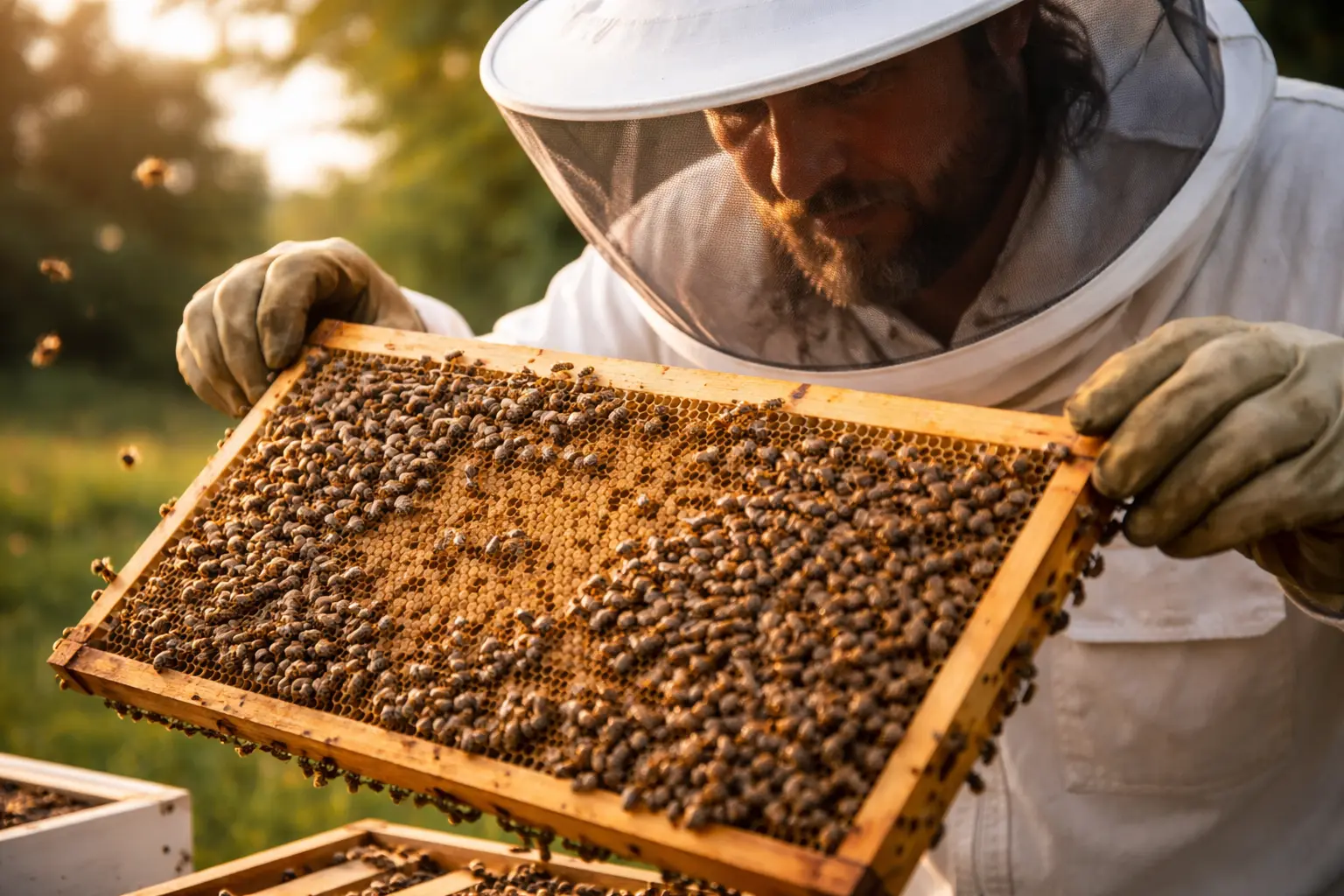
Queenless Colony (UK)
Queenless Colony – Signs and What To Do (UK Guide)
Last updated: 15 August 2026
A queenless colony is a hive that has lost its queen or no longer has a laying queen. Sometimes this is obvious, but often it is not. Before taking action, check for eggs, young larvae, queen cells and the general behaviour of the colony.
Common signs of a queenless colony
- No eggs or very young larvae.
- Patchy or declining brood pattern.
- Colony sounds unsettled or “roaring”.
- Bees may appear more defensive or restless.
- Emergency queen cells may appear on brood comb.
- In later stages, laying workers may develop.
How to confirm if the colony is queenless
Do not rely only on whether you can see the queen. Many colonies are queenright even when the queen is not found during an inspection.
- Look for eggs: eggs usually mean a queen was present within the last three days.
- Look for young larvae: this suggests recent laying activity.
- Check queen cells: emergency queen cells may suggest the colony is trying to replace a lost queen.
- Use a test frame: adding a frame with eggs from another healthy colony can help confirm queenlessness.
Why colonies become queenless
- The old queen has died.
- The queen was lost during an inspection.
- The colony has swarmed and the new queen has not yet started laying.
- A virgin queen is still on mating flights.
- Supersedure has failed.
- A new queen has failed to mate properly.
What to do with a queenless colony
The right action depends on timing. A colony that has recently swarmed may only need time, while a colony with no queen, no brood and no queen cells may need intervention.
- If eggs are present: the colony is probably not queenless.
- If queen cells are present: check whether they are emergency, swarm or supersedure cells before acting.
- If a virgin queen is likely: avoid disturbing the colony too much and allow time for mating.
- If queenlessness is confirmed: consider adding a test frame, introducing a queen, uniting with another colony, or seeking local advice.
Common mistakes to avoid
- Assuming the colony is queenless just because you cannot see the queen.
- Destroying queen cells without understanding why they are there.
- Introducing a queen too soon when a virgin queen may already be present.
- Opening the hive repeatedly during the mating window.
- Leaving a truly queenless colony too long until laying workers develop.
How this links to the Bee Health Checker
This page supports checker outcomes where queen status, brood pattern or lack of eggs suggest the colony may be queenless, in a brood break, or waiting for a virgin queen to mate.
- Queenless likely.
- Possible brood break.
- Virgin queen or mating window.
- Supersedure underway.
- Laying workers suspected.