
Queen status problem
Drone-Laying Queen in Bees – Signs, Causes and What To Do
Last updated: 15 August 2026
A drone-laying queen is a queen that is laying mainly or only unfertilised eggs. Those eggs become drones rather than worker bees, so the colony slowly loses the worker population it needs for feeding brood, foraging, guarding, cleaning and winter preparation.
The confusing part is that the queen may still be present. You may see eggs, larvae and sealed brood, but the colony is not replacing itself properly. That is why a drone-laying queen can be missed if you only check whether a queen exists, rather than checking what type of brood she is producing.
This guide links closely with queen failing signs, laying workers, queenless colony decisions and brood problem checks.
Signs of a drone-laying queen
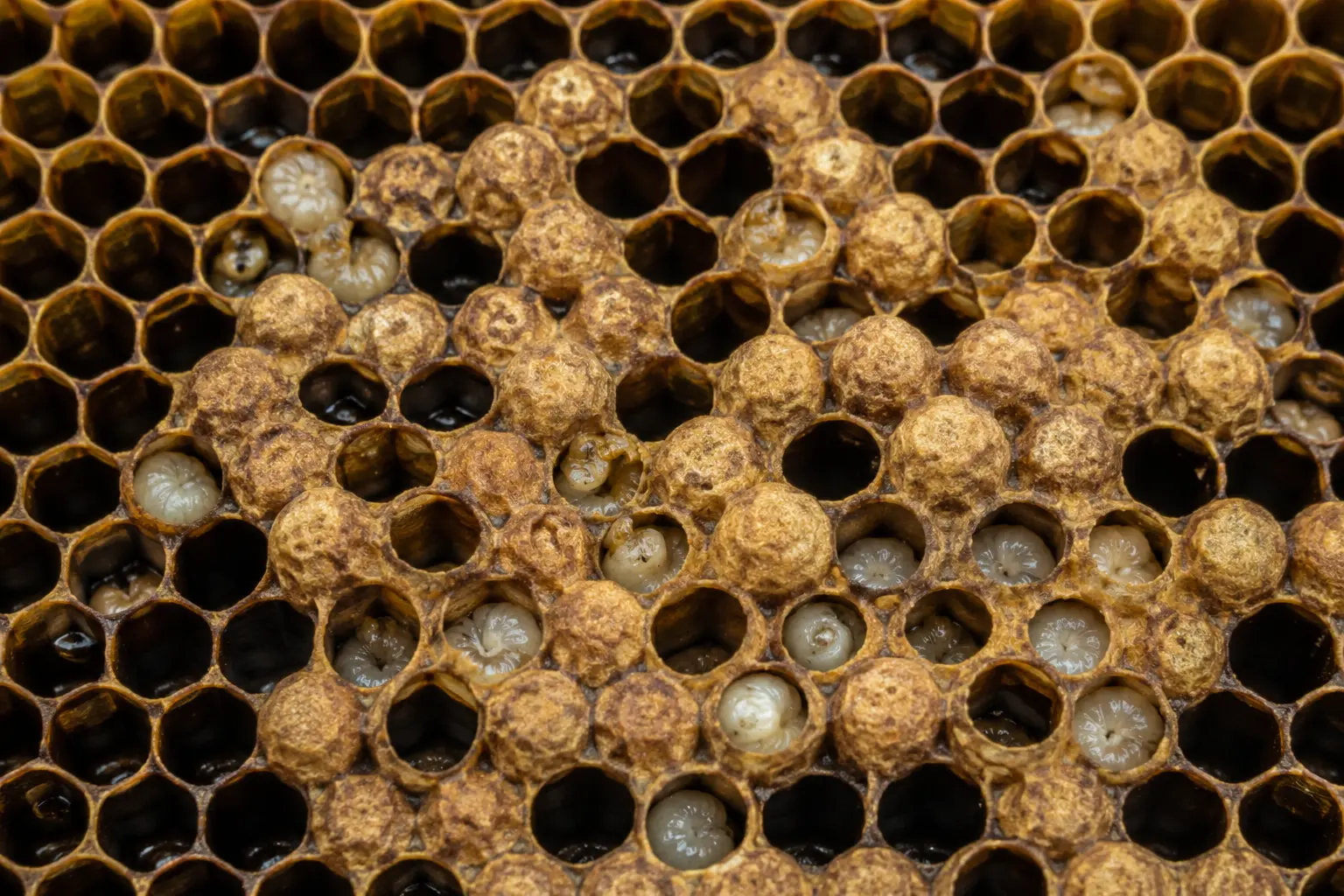
The main warning sign is not simply the presence of drones. A healthy colony normally produces some drone brood in spring and summer. The concern is when drone brood appears where worker brood should be, especially if the brood area is covered with raised, domed cappings and there are few signs of normal worker larvae.
A drone-laying queen often leaves a pattern of single eggs neatly placed in cells, but those eggs develop into drones. The brood pattern may look patchy, bumpy or uneven. You may still find the queen walking on the comb, which can make the colony appear queenright at first glance.
If the colony is weakening at the same time, with fewer young workers coming through and little worker brood to replace older bees, treat it as a serious queen problem rather than a normal seasonal patch of drone brood.
What drone brood in worker cells looks like
Drone brood needs more space than worker brood. When drones develop in worker-sized cells, the cappings are often pushed upwards into a raised, bullet-shaped or domed appearance. Instead of a smooth area of worker brood, the comb can look lumpy and irregular.
A small amount of drone brood around the edge of the brood nest is not unusual during the active season. What matters is the balance. If most of the brood is domed, raised or scattered, and normal worker brood is missing, the queen may be poorly mated, failing or no longer able to produce fertilised eggs.
What causes a drone-laying queen?
A drone-laying queen is usually linked to mating failure, age or damage. A young queen may not have mated properly because poor weather interrupted her mating flights, because there were not enough suitable drones available, or because she missed the successful mating window.
An older queen can also become drone-laying if her stored sperm runs low. She may continue to lay eggs, but more of those eggs are unfertilised. Damage to the queen can cause similar problems, particularly if her laying pattern changes suddenly after handling, manipulation or a difficult period in the hive.
If this follows a split, missed swarm or queen replacement, compare what you are seeing with the virgin queen timeline before deciding too early.
Drone-laying queen or laying workers?
Drone-laying queens and laying workers are often confused because both can result in drone brood where worker brood should be. The egg pattern is usually the best clue. With a drone-laying queen, eggs are commonly laid one per cell and placed neatly on the cell base.
With laying workers, there are often several eggs in the same cell, and many eggs are attached to the cell walls or placed irregularly. A laying worker colony is usually queenless and has been queenless long enough for some workers to begin laying unfertilised eggs.
This distinction matters because introducing a new queen into a laying worker colony is much harder than replacing a failing queen in a colony that still has normal worker behaviour.
Drone-laying queen or normal drone brood?
Normal drone brood is part of a healthy colony during the active season. It is usually found in drone-sized cells, often near the edge of the brood nest or in patches of comb built for drones. The colony should still have worker eggs, worker larvae and sealed worker brood.
A drone-laying queen becomes more likely when the brood nest is dominated by drone brood, the worker brood has largely disappeared and the colony is getting weaker.
What happens if you leave it?
If a drone-laying queen is left in place, the colony usually declines. Drones do not carry out the full range of worker bee jobs, so the colony cannot maintain itself as older workers die.
In early season, a strong colony may have time to recover if the failing queen is dealt with quickly. Late in the season, or in a colony that is already small, combining may be more realistic than trying to save it as a separate unit.
What to do if you suspect a drone-laying queen
First, confirm what you are actually seeing. Check whether the queen is present, whether eggs are single and neatly placed, whether there is any normal worker brood and whether the colony still has enough worker bees to recover.
If the queen is present and the evidence points to a drone-laying queen, she usually needs to be removed before any replacement queen is introduced. A colony that still has enough workers may be requeened, but a very weak colony may be better combined with a stronger colony.
If you cannot find the queen, use the missing queen checklist and the queenless colony guide before acting.
When requeening may work
Requeening is more likely to work when the colony is still reasonably strong, has enough young workers, is not badly stressed and the failing queen has been removed. The replacement queen also needs to be introduced carefully, with enough time in the season for the colony to rebuild.
Requeening is less likely to be worthwhile if the colony has already dwindled badly. Even a good queen needs a workforce around her.
When combining may be better
Combining may be the better option when the colony is weak, the season is late, the worker population is too small or the colony is unlikely to build up before poor weather arrives.
Before combining, make sure you understand whether you are dealing with a failing queen, a queenless colony or laying workers. If the colony is generally weak as well, compare it with the weak colony guide.
Common mistakes to avoid
The first mistake is assuming that all drone brood means the queen has failed. A healthy colony can produce drones in season. The second mistake is introducing a new queen while the old drone-laying queen is still present.
Another common mistake is confusing laying workers with a drone-laying queen. The actions can be different, and laying worker colonies are often much harder to correct.
How to reduce drone-laying queen problems
You cannot prevent every queen failure, but good records make problems easier to catch early. Track queen age, queen replacement, swarms, splits, supersedure events and the date when a new queen should reasonably be laying.
Brood pattern notes are particularly useful. A simple record of eggs, larvae, sealed worker brood, drone brood and queen sighting can show whether the colony is improving, stalling or heading into decline.
How HiveTag can help
Drone-laying queen issues are easier to spot when queen events and brood changes are recorded over time. HiveTag can help you keep inspection notes on queen sightings, eggs, brood type, mating windows, colony strength and follow-up tasks.
Learn more about the HiveTag beekeeping app.
Drone-Laying Queen FAQ
The queen herself cannot usually be fixed. The colony may recover if she is removed and replaced with a good queen early enough, provided there are still enough worker bees to support recovery.
A drone-laying queen usually lays one egg per cell, neatly on the cell base. Laying workers often produce multiple eggs per cell, with eggs scattered or attached to the cell walls.
No. Some drone brood is normal in the active season. It becomes a problem when most or all brood is drone brood, especially when domed cappings appear in worker-sized cells and the colony has little or no worker brood.
Combining may be better than requeening if the colony is very weak, has too few workers left, or the season is too late for reliable recovery.